Lake Tahoe Lahontan Cutthroat Trout Stocking Program

Category : , , , , Off

Over the next few months, approximately 22,000 Lahontan cutthroat trout (LCT) will be stocked in Lake Tahoe. The cutthroat trout will be approximately nine inches in length when released.

This is the first time in more than 35 years that the Nevada Department of Wildlife (NDOW) will be stocking Lake Tahoe with Lahontan cutthroat trout, the only trout species native to the Basin.

In response to a growing interest in the Tahoe area for the restoration of native species, an interagency team was created to explore opportunities to restore LCT to the Basin.

The team identified NDOW's stocking efforts at Lake Tahoe as an opportunity to provide anglers with the chance to catch native Lahontan cutthroat trout.

For more information, visit www.ndow.org

Fishing Access in North America

Category : Off

In North America, fishing access is an important issue for anglers. In the USA, access for freshwater fishing is often available within state parks, local facilities and national refuges.

Fishing is permitted on more than 270 national wildlife refuges. Other wildlife-dependent recreation on national wildlife refuges includes wildlife photography, environmental education, wildlife observation and interpretation.

Under the National Wildlife Refuge System Improvement Act of 1997, the Service can permit hunting and fishing as well as four other types of wildlife-dependent recreation where they are compatible with refuge purpose and mission. Hunting, within specified limits, is permitted on more than 300 national wildlife refuges.

How Catch Crappie and Sunfish in Heavy Vegetation

Category : , , , , Off


Fishing for crappie and sunfish can be rewarding for anglers with patience. During the summer season, fishing can sometimes be frustrating as these species often retreat into areas of heavy vegetation. Fortunately, weedless lure designs allow anglers to target these fish in areas where conventional tackle is completely useless.

Black crappie, white crappie, and several species of sunfish are popular among North American anglers. These hard fighting members of the sunfish family are known for their habit of hiding among aquatic grasses and other plants.

Many of these panfish seem to have insatiable appetites and will sometimes attack anything that hits the water near grass beds or other hiding spots.

This feeding behavior can be exploited by anglers, although fishing around dense aquatic vegetation requires specialized tackle and plenty of patience

When fishing heavy cover for crappie and sunfish with artificial lures, the list of options is very short. Lure designs must be weedless, otherwise the angler will only grow frustrated as each cast yields nothing but strands of plant material..

Fly fishermen have the advantage when it comes to fishing areas where grass is abundant. Most fly anglers choose bugs or poppers which are made especially for fishing in areas of dense vegetation.

For anglers that prefer ultralight spinning tackle, small weedless spoons are one option for fishing in heavy cover. These traditional lures are able to wobble across aquatic vegetation without fouling. Downsized plastic worms, tubes or grubs can also be rigged in weedless configurations for fishing around heavy aquatic vegetation on the water's surface.

All of these designs share a few common traits. To be effective in heavy cover, the running line must to connect to the lure at the top center (unlike jigs). Additionally, there must be some shielding of the hook and barb, so that it will not pick up vegetation as it moves thru areas of growth. Weedless lures must also float, be neutrally buoyant, or slow sinking. Any design that sinks fast will tangle in submerged weeds and fail to produce strikes. 

Regardless of the lure chosen, the technique remains basically the same. Anglers move slowly and quietly among aquatic plants, casting towards productive areas. Lures are slowly worked across vegetation or casted directly into open patches of water.

For bait fishermen, dense vegetation also creates challenges. Some anglers deal with plants by making extremely accurate casts into nearby open areas. For the heaviest cover, a specialized crappie pole or cane pole can be useful. These simple rods allow anglers to drop baits into even the smallest of openings. When a bite is detected, the angler must lift the fish straight out of the water before it can entangle the line in the vegetation below.

Freshwater Fishing Areas in Georgia

Category : , Off

Among the best places to go freshwater fishing in Georgia are the state's many Public Fishing Areas (PFAs). These areas are home to bass, crappie, sunfish, catfish and other species of freshwater fish.

Georgia PFAs offer a variety of fishing opportunities, from lakes several hundred acres in size to ponds less than one acre. Some are designated as kids-only fishing ponds while others are managed for trophy bass. Anglers can fish from a boat, along the shoreline or from a pier at most locations. Many areas have picnic tables, nature and wildlife observation trails, fish cleaning stations and restroom facilities. Some offer primitive campsites for those wishing to stay overnight on the area, and many facilities are accessible to persons with disabilities.

The following list offers information about Georgia PFAs:

McDuffie County PFA
Located eight miles east of Thomson on 570 acres in Georgia’s upper coastal plain. Includes 13 ponds ranging from one to 30 acres, a fish hatchery and an education center. Species: largemouth bass, bluegill, redear sunfish and channel catfish.

Big Lazer Creek PFA
Located ten miles east of Talbotton in west central Georgia. Includes a 195-acre lake. Species: bluegill, channel catfish, crappie and largemouth bass.

Marben Farms PFA
Offers 6,400 acres in central Georgia, three miles south of Mansfield in Jasper and Newton counties. Includes 22 ponds ranging from one to 95 acres, a wildlife management area and an education center. Species: largemouth bass, bluegill, redear sunfish, crappie and channel catfish.

Dodge County PFA
Located on 444 acres in Georgia’s middle coastal plain, four miles southeast of Eastman. Includes a 104-acre lake. Species: largemouth bass, bluegill, redear sunfish, channel catfish and crappie.
Evans County PFA: Located on 372 acres, nine miles east of Claxton. Includes three lakes ranging from eight to 84 acres. Species: crappie, largemouth bass, bluegill and catfish.

Flat Creek PFA
Located in Perry, this 108-acre lake includes a concrete boat ramp. Species: largemouth bass, bluegill, redear sunfish and channel catfish.

Hugh M. Gillis PFA
Located on 640 acres in Laurens County, 12 miles east of Dublin. Includes a 109-acre lake. Species: largemouth bass, bluegill, redear sunfish, channel catfish and crappie.

Paradise PFA
Located in south central Georgia, eight miles east of Tifton on 1,250 acres. Includes 60 lakes totaling 525 acres. Species: largemouth bass, sunfish, crappie and channel catfish.

Ocmulgee PFA
Nestled within the boundaries of the Ocmulgee wildlife management area, eight miles north of Cochran in Bleckley County. Offers a 106-acre lake. Species: trophy largemouth bass, crappie, bluegill, redear sunfish and channel catfish.

Rocky Mountain PFA
Located 16 miles north of Rome on 5,000 acres in Floyd County. Offers two lakes totaling 559 acres. Species: largemouth bass, walleye, bluegill and redear sunfish, channel catfish, crappie and hybrid striped bass.


For more information on Georgia PFAs, visit www.gofishgeorgia.com

source: Georgia Department of Natural Resources

New Jersey State Record Bowfin

Category : , , Off

A bowfin caught by Chris Hoffman of Hamilton, NJ, has been confirmed as a new state record for the species by the NJDEP Division of Fish and Wildlife.

Mr. Hoffman was fishing for largemouth bass from his boat in the Delaware River near the Mercer Generating Station in Trenton, NJ. on July 4, 2011, when the fish grabbed a 4" soft plastic Senko fish on  6 pound line.

The 10 lb. 14 oz. bowfin, was 29.9" long and had a girth of 14.6". It broke the old record, set 23 years ago in 1988, by 2 lb. 10 oz.

The bowfin is a predatory fish that feeds on frogs, fish, and other prey.

For details on the New Jersey State Record fish program, see: www.njfishandwildlife.com/recfish.htm

Small Pond Fish Problems

Category : , , , Off

Farm ponds, mill ponds and other small waterways are subject to a variety of fish-related problems. Many of these problems are simple to correct, once identified.

A lack of fish in small ponds can be caused by excessive harvesting by humans or predation by wildlife. Pond owners usually harvest a few fish for consumption. In some cases, unknown to the landowner, poachers may also remove fish from private ponds.

In addition to human anglers, a variety of wild predators are skilled at catching fish and in some cases can have considerable impacts on fish populations.

Otters are known to be one of the most efficient predators that visit small ponds. These playful aquatic mammals can eat their weight in fish in a matter of days. Raccoons are another fish-eating mammal, although their efforts are usually limited to shallow areas along the shoreline. Both red and gray foxes are also capable of catching fish in shallow water. Black bears are usually the largest predator to visit farm ponds. These omnivores are capable of causing a considerable disturbance to farm ponds or other small bodies of water.


Birds can have a big impact on fish populations, especially in shallow ponds. Herons and egrets are among the most deadly. Other predatory birds include ospreys, eagles and kingfishers.

Reptiles, including turtles and water snakes take fish from most ponds. Usually these predators do not eat large numbers of fish and the losses are a normal part of fish life cycles.

In addition to predators, environmental factors can affect fish populations in small impoundments.Cold winter temperatures can also harm fish. Most species of freshwater fish have minimum temperature thresholds below which they become stressed or die.

Spring can also be a dangerous time for fish populations, especially in small ponds. In many areas, aquatic vegetation dies off in winter and settles on the bottom. When spring arrives, warm temperatures cause dead plant material to break down, which in turns causes oxygen levels to plummet. The situation, known as hypoxia, can cause large scale fish kills.

During summer, droughts can lower water and oxygen levels, as well as causing water temperatures to skyrocket. Hypoxia can again stress or kill fish as they crowd into small spaces without sufficient oxygen to sustain them.

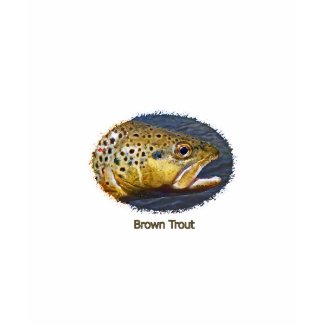
Brown Trout T Shirts - Accessories

Category : , , , , Off

Brown trout are always popular among anglers and fish art enthusiasts. They are widely acclaimed to be one of the most beautiful species of freshwater trout.

Appearances of brown trout vary greatly from region to region. Most adult fish are olive-green or brownish above, with cream and golden-yellow along the sides. The belly is usually whitish. Brown trout usually have black spots along their sides, back and dorsal fin. These spots are outlined by a lighter colored halo.

The brown trout belongs to the genus Salmo, a group that also includes Atlantic salmon and other species. Anadromous forms of brown trout also exist (sea trout).

Brown trout were introduced into North America in the 1800's. The species quickly established itself in the
lakes, rivers and streams of the northern U.S., Great Lakes Basin and other areas.

In North America, brown trout often reach weights of 8 pounds or more. Some individuals grow much larger. The world record for brown trout is shared by 2 fish, both of which weighed over 41 pounds.

Browns are considered to be among the most challenging trout species to catch. They are also prized for their size and quality as a food fish.

Brown trout t-shirts, hats, coffee mugs and other collectibles make excellent gifts for fly fishermen or anyone that enjoys wildlife.

The following designs are just a sample of the many trout, salmon, char and other freshwater and saltwater fish logos that are available at fish_fishing_seafood online store.


Powered by Blogger.